
Before I ever worked in roofing, I spent years knocking doors in pest control. Day after day, neighborhood after neighborhood. What I learned had very little to do with scripts and everything to do with proximity, timing, and social proof. The most effective conversations were never truly cold. They worked because something had already happened nearby. A truck in the driveway. A technician walking the property. A neighbor asking questions. People notice activity in their neighborhood, and once they do, comparison starts immediately. That is the bandwagon effect. It is keeping up with the Joneses. It is human nature, and it is real.
This post explains why permits are one of the most overlooked marketing assets in roofing and why the team at HomeHudl is building the My Market page to take advantage of that moment.
When I Moved Into Roofing, I Saw the Same Dynamic
When I moved into roofing and storm restoration, I saw the exact same dynamic. The difference was that contractors were already paying for the strongest possible signal of legitimacy and timing, yet almost no one was extracting value from it. That signal is the permit.
Permits Are a Sunk Cost That Contractors Rarely Leverage
Every serious roofing contractor pulls permits. It is required, it costs money, and it signals professionalism. Some contractors spend a few thousand dollars a year while others spend tens of thousands. In Madison alone, the top roofing company by permit count spent well over fifty thousand dollars on roofing permits last year. Most contractors treat that cost as purely administrative. You pull the permit, you build the roof, and you move on.
What often gets missed is that a permit is not just paperwork. It is a public declaration that work is happening at a specific address, at a specific time, in a specific neighborhood. That timing is everything.
What Door Knocking Taught Me About Neighborhood Momentum
When you knock doors long enough, patterns become obvious. The easiest conversations are not random. They happen when neighbors have already noticed something nearby. A truck parked out front for two days. The sound of a nail gun. Materials stacked in the driveway. People talk. Curiosity builds. Comparison follows. Homeowners ask themselves a simple question: why did my neighbor need work, and do I need it too?
Good sales reps already lean on this instinctively. They say things like "we are already working with a few of your neighbors" or "we just finished the house down the street." It works because it is true, visible, and timely. Roofing has this same dynamic, but at a larger scale. Roofing work is loud, obvious, and impossible to ignore. A neighborhood knows when a roof is being replaced. The mistake is waiting too long or marketing too broadly.
The Problem With Traditional Mailers
Most contractors who use direct mail do it at the ZIP code level. Thousands of homes at once. Low intent. Poor timing. High cost. You end up paying to reach homeowners who have no reason to care at that moment. No visible work nearby. No urgency. No social proof. Mailers themselves are not the problem. The targeting is. When outreach is sent to an entire ZIP code, most of the spend goes toward noise rather than momentum.
A Permit Is a Trigger, Not Just a Requirement
The moment a permit is pulled and work begins, something changes in that neighborhood. Neighbors are already paying attention. They hear the work. They see the crew. They know something is happening. That is the moment when outreach actually makes sense. Not weeks later. Not broad coverage. Right then.
This insight is what led the team at HomeHudl to build the My Market page. The goal was simple: turn permits from a sunk cost into a trigger.
How My Market Works in Practice
My Market allows contractors to market outward from permits they have already pulled. Instead of targeting an entire ZIP code, contractors can target homes within roughly a three hundred meter radius of a permitted job. These are the neighbors who already know work is happening. Mailers are tied directly to real projects, not generic branding. Contractors can upload before and after photos from the permitted job, and outreach shows proof of work rather than promises.
This creates a bandwagon effect that already exists naturally, but makes it intentional and measurable. Rather than telling homeowners you are reputable, you are showing them work that is happening on their block.
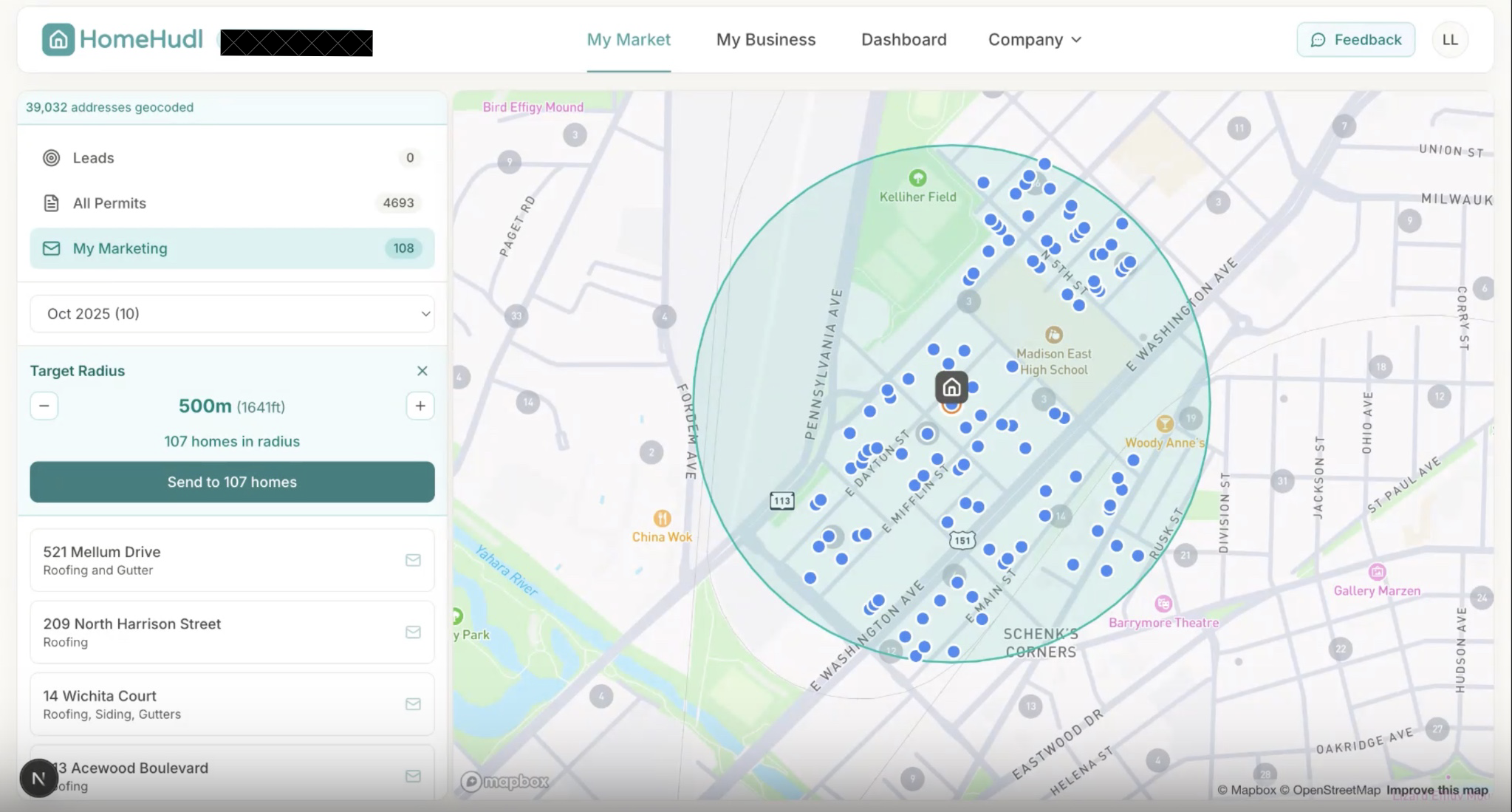 The My Market page.
Why This Saves Money and Improves Conversion
When the audience narrows, costs drop immediately. Fewer mailers are sent, but to higher intent households. People who have already noticed activity. People who are already comparing. People who are already asking questions. Instead of spending marketing dollars on homes unlikely to respond, spend is focused where attention already exists. This is not about being louder. It is about being precise.
Proof of Work Beats Claims Every Time
In door-to-door sales, credibility matters more than persuasion. Homeowners are skeptical for good reason. What consistently works is proof. Being able to point to real work nearby. Being able to say, this is what was just done. Permits make that proof objective. Photos make it visual. Proximity makes it relevant. When neighbors receive a mailer showing real work completed nearby, it feels different. It feels grounded. It feels earned.
Compounding Value Over Time
There is a second effect that matters just as much. As contractors use My Market, they are not only sending mailers. They are building a public record of their work. Each permit adds to their profile. Each job adds proof. Over time, homeowners researching contractors see a history of real projects rather than marketing claims. The value compounds. A permit stops being a one-time cost and becomes an asset that continues to generate trust and future revenue.
Planting a Flag Through Transparency
At its core, this is about territory and transparency. When a contractor pulls a permit, they are making a public commitment to do the job the right way. My Market extends that commitment outward. It allows contractors to plant a flag in their neighborhoods by showing their work openly and intentionally. Not through aggressive advertising. Not through inflated claims. Through visibility and proof.
That is how trust is built locally. That is how strong contractors separate themselves. And that is why permits remain one of the most undervalued marketing assets in roofing.
👉 Want to turn your permits into better local follow-up? Create your account.