Most roofing direct mail fails for a simple reason: it starts with a ZIP code instead of a job. Contractors send thousands of identical postcards with no timing, no proof, and no reason for that homeowner to care today. You end up paying to reach people who just got a new roof, live outside your service area, or have already gotten the same piece twice. Mailers are not the problem. The targeting is.
Roofing is loud and visible. Neighbors see the dumpster, the trucks, the crew, and the finished roof. A postcard can mean something in that moment if it is tied to work that is actually happening nearby.
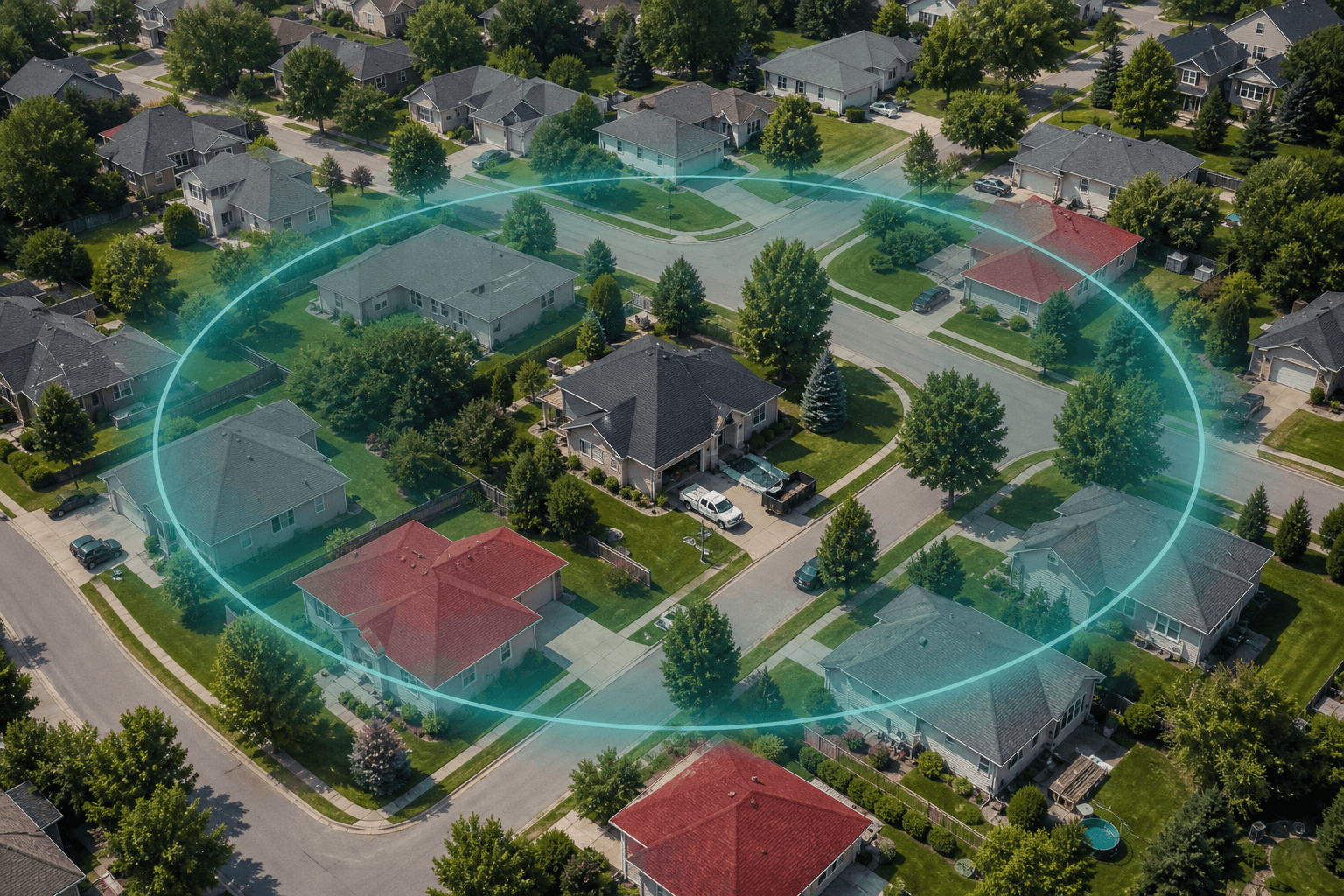
That is the version of roofing direct mail we care about at HomeHudl. Start from a completed or active job, mail the homes around it, cut the obvious waste, and keep a record of what you sent.
Stop spraying the whole ZIP code
If your process is “pick a ZIP, drop a design, hope,” you are buying noise.
A better campaign starts with an anchor job: a roof you just finished, a job about to install, or a permitted project in a neighborhood you want to grow. That address becomes the center. You select nearby homes. You do not pretend every household in the carrier route has the same reason to hear from you.
Some contractors still use Every Door Direct Mail (EDDM) or other broad route mail when they want cheap saturation. Fine for a branding blast. It is not what we mean by a job-centered campaign, and it is not what HomeHudl is built around. We care about address-level targeting around real work, not blanketing every door on a postal route.
Build the list like a sales rep would
A strong list answers two questions: why this neighborhood, and why this home?
Neighborhood is easy when the job is real. The home takes filtering. Stay close enough that “we’re working nearby” is still true. Drop commercial or multifamily if you only want residential owners. Suppress your own recent customers unless the message is referrals or maintenance, and suppress people you already mailed unless this is a planned follow-up. Honor do-not-mail requests and stay inside the territory your crew can actually serve. Where you have permit data, use recent roofing permits as exclusions so you are not paying to pitch a house that just replaced the roof.
You will never have a perfect list. You can have a defensible one.
The postcard should explain why it showed up
Homeowners decide in a few seconds. Lead with a true local reason, like “We just finished a roof near you.” Show real proof with a project photo, reviews, and license info if required, not stock photos or vague “best roofer in town” claims. Give one offer, one clear next step with a trackable number, URL, or QR, and urgency only if it is honest.
If you are storm-related, invite an inspection. Do not claim their house has damage you have not seen.
One touch is easy to miss. A short sequence around the same job, before install, after completion, then a different follow-up, usually beats mailing the same card three times. Keep history so you do not overmail by accident.
Judge campaigns by jobs, not vibes
Response rate alone will lie to you. A campaign can generate calls and still lose money. Another can create one signed roof and pay for itself.
Track what matters: what you spent, what came back as inspections and signed work, and whether the gross profit on attributed jobs cleared the campaign cost. Expand what works, drop what does not, and skip the fake calculator examples. For why roof replacements can beat a higher lead count, read Roofing Direct Mail ROI. Most campaigns go wrong when the list is too broad, recent roofs are not excluded, every offer uses the same hail card, damage claims cannot be supported, or one shared phone number makes attribution impossible.
Make it a system, not a monthly scramble
The best version is a loop, not a monthly scramble. A real job or permit becomes the anchor. Nearby homes get selected. Low-probability and duplicate addresses get cut. The message shows local proof. Touches are intentional. Leads and signed jobs get attributed back. The next campaign uses what you learned.
HomeHudl for contractors is built around that same idea: use the work you already do to reach the right nearby homes, without another blind ZIP code drop.
Claim your business to get started.
If you are also deciding between door hangers and postcards, read Roofing Door Hangers vs. Postcards.
FAQ
What is the best mailing list for a roofing company?
Homes near a real completed or active job, after you remove bad fits, recent roofs, suppressed addresses, and anything outside your territory.
How far should you mail from a job?
Tight enough that “nearby” is believable. Start close, watch what converts, expand only if farther homes still pay.
Is EDDM the same as roofing direct mail?
No. EDDM is broad route saturation. Job-centered radius mail is address-level targeting around work you are actually doing. Different tools. Different intent.
How many times should you mail?
One piece is easy to ignore. A short sequence of different messages usually teaches you more than repeating the same card, as long as you track results and respect suppression.